
Gloster’s position at the forefront of the global luxury outdoor furniture market is a project that represents a major triumph; both identifying how far our brand has come, while simultaneously emphasizing the defining standard we continually strive to maintain. An essential part of this persistent pursuit are the supporting structures that allows our brand to deliver world-class products to our clients, and no structure is more important to this mission than our operations in Indonesia. As the site of our teak production & harvesting, metal factory, product manufacturing, and as a logistical nerve center, our operations in Surabaya, Indonesia act as the foundation on which our entire brand is built. In 2023, the Gloster Newsletter will celebrate this keystone of our global operations by sharing interviews with key members of our Indonesian operation and showcasing how their contributions fit into Gloster’s global mission to be a leader in our industry.
Tim Cook has been the Product & Development Manager for the last 12 years with Gloster Indonesia, and brings more than 30 years of experience in the furniture industry to the table. We recently caught up with Tim to ask about his role in our operations and how he works with Gloster’s world-renowned furniture designers to turn their designs into finished products.
Gloster: Tim, how do you develop and maintain relationships with the furniture designers behind all of Gloster’s products?
Tim: We only work with a small group of select designers who have become part of the Gloster brand story over many years. We tend to form long-term partnerships with our designers; over time, they come to be as much a part of the Gloster family as any of our own employees.
Gloster: Can you discuss a time when you first came into contact with a designer new to Gloster and the designs they had created? What is the process of getting to know these designers like, and how did things grow from there?
Tim: One of our longest serving designers is Mark Gabbertas, a British furniture designer who first started working with Gloster more than 15 years ago. Most recently we have worked with Mark on the introduction of the Saranac and Omada ranges, and it has been wonderful to see our relationship grow over time. Someone who has been intrinsic to our brand journey over the last 9 years has been Danish designer Henrik Pedersen. I remember my first meeting with Henrik on a Gloster exhibition stand where we reviewed his modular seating concept that later became Grid. After that, the rest is history! The 2023 season will see the launch of a major new range designed by Henrik—Bora, a unique design combining solid teak frames with outdoor wicker seats and luxuriously soft cushions.
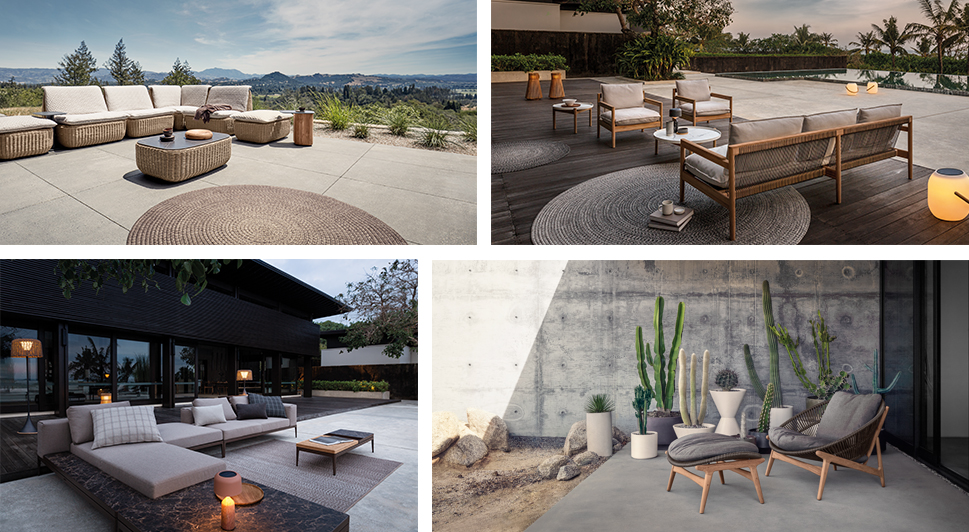
Omada & Sarnac by Mark Gabbertas; Grid & Bora by Henrik Pedersen.
Gloster: How often are you in communication with our furniture designers as you are working to produce their designs? What does this communication look like?
Tim: During the early development stages of any new product, communication with the designer is essential and tends to happen very frequently—often several times each day. We begin by sharing our 3D CAD drawings with the designer before committing to the prototyping process in order to iron out as many details as possible before we make the first physical sample. Once we have the first samples, we share images with the designers for feedback; after that step, we incorporate any feedback and begin the process anew. This gets repeated until we’ve reached the approval stage where both we and the designer are satisfied with the result.
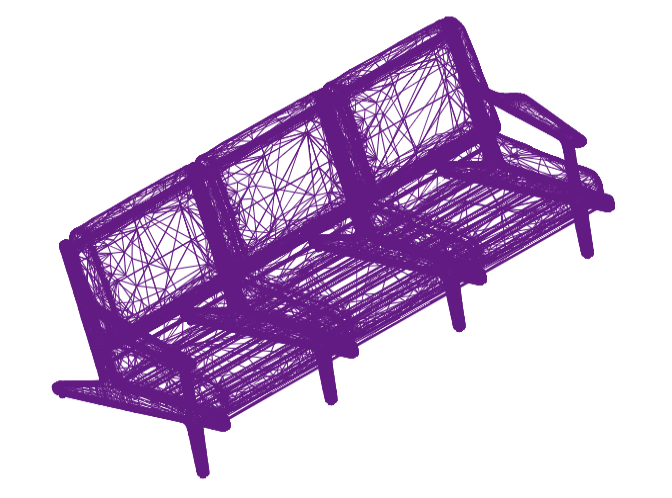
CAD Drawing Bay 3-Seater Sofa.
Gloster: What are some of the most important steps to get a product from the early stages of development to its final form? Are there any tests we put our products through to ensure they have the level of performance needed?
Tim: In reality, there should be very little difference between a prototype and a mass-produced item, because we are considering mass production at every stage of the process. Our skilled craftspeople in our prototype workshops will use conventional machinery and hand making techniques to follow every specification, and our production leaders are included throughout the development process to ensure a smooth transition from development to production.
We test all our products beyond industry norms for outdoor furniture in our fully equipped, in-house laboratory. We use the European Norms for outdoor furniture and test our products to the highest level (level 3), which is for furniture for use in a contract/hospitality environment. Both the strength and durability of the products are tested under our protocols, with one chair needing to withstand 50,000 applications of a test load in order to pass.
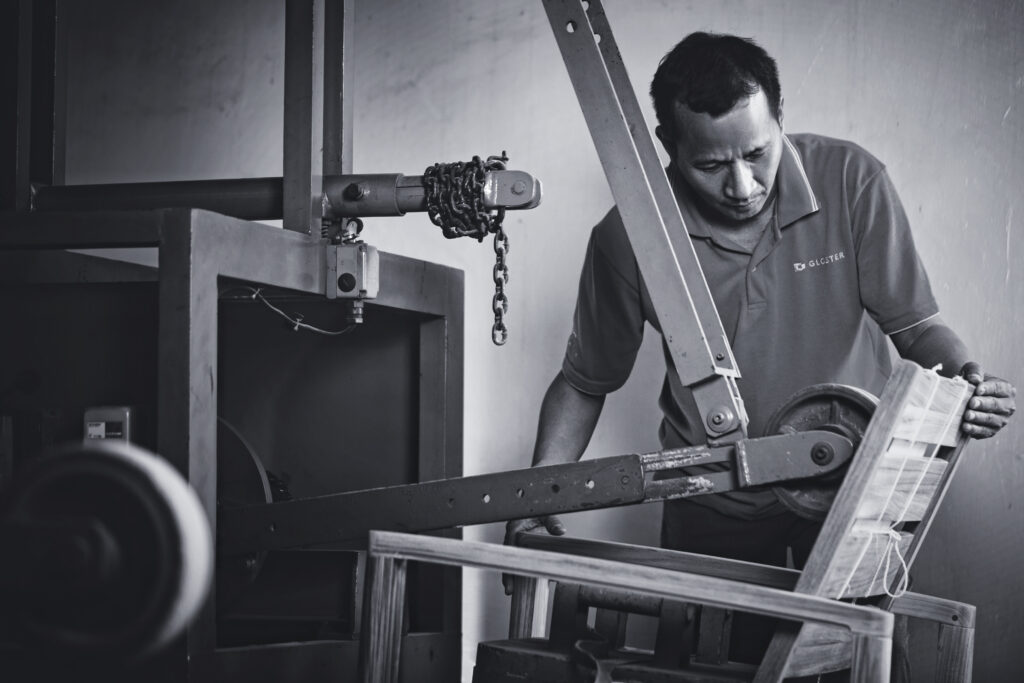
Product Testing.
Gloster: What are some of the biggest positive changes you’ve seen during your 12 years with Gloster?
Tim: For me, the biggest positive change has been the way that we have established Gloster’s position as the leader in the premium outdoor furniture market. We’ve done this by crafting a product assortment that capitalizes on key Gloster attributes and capabilities, the foremost of which is Teak. The second biggest change is the way we’ve grown our focus on utilizing in-house production capabilities; all Gloster furniture products are manufactured under our own roof here, and we take complete control of the manufacturing process and can ensure the quality of our products through our dedicated Quality Assurance team.