
Over the course of 2021, Gloster’s quarterly newsletters will periodically provide a glimpse into the origins and history of our company to help tell the story of our growth into a premiere luxury outdoor furniture manufacturer and to highlight the business, community, and environmental practices that have long been cornerstones of Gloster.
In our Quarter 1 Newsletter, we discussed the journey our founder Paul Wallevik took in moving Gloster’s manufacturing home to it’s current destination in Surabaya, Indonesia, the origins of the Gloster brand, and the 1992 business deal that brought it all together. To catch up on what you may have missed, read our first chapter of Gloster History here.
Before Paul Wallevik purchased Gloster in April 1992 to incorporate it into the newly established Kingfurn operation, the brand had a far different identity than the one it would soon adopt. Originally established in 1982 and based in central Bristol, U.K., Gloster’s first entry into the outdoor furniture market was as a producer of pure teak products—most predominantly, traditional English benches. The heavier and generically styled furniture was sold to a moderately sized domestic U.K. market and a small multinational European following through a network of distributors. Paul, already with a growing list of bold business decisions to his résumé, made another when the purchase of Gloster was finalized. He quickly shuttered Gloster’s manufacturing operations at the central Bristol site and exported virtually all of the machinery and tools used for production to the rapidly expanding Kingfurn facility in Surabaya, Indonesia. In its place, a new office and warehouse was quickly established on the outskirts of Bristol that would soon become the main center of operations for the new business.
Around the same time in which operations were being transferred from Bristol to Kingfurn, a circumstantial encounter would introduce Paul to the man who would quickly ascend to the post of designer of choice for the reimagined Gloster Brand: Povl Eskildsen. A graduate from the 1986 class of the School of Architecture in Aarhus, Denmark, Povl was presenting his new concept outdoor folding chair at the Copenhagen Furniture Fair when Paul came across his display and immediately recognized the design’s potential. Quite unlike other folding chairs of the period, Povl had incorporated an innovative lumbar support in the back, utilized a different folding principle that kept the front of the seat visible when folded, and included a simple, integrated handle that could be used for folding and carrying the chair. In short order a deal was struck and the iconic Weston Folding Chair was born. As the first foray into the innovative design sphere that Gloster would make, this collection would come to sell well over 20,000 units per year at the peak of its run.
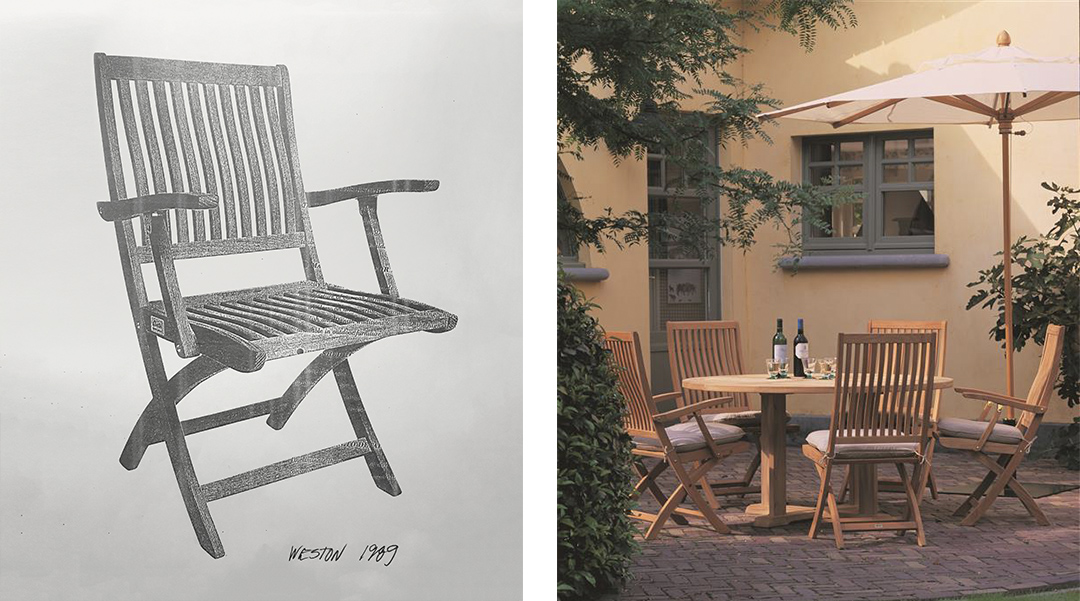
Left: An early prototype of the Weston Folding Chair. Right: The Weston Dining Set
As the years since the acquisition of the Gloster brand and alignment with the Kingfurn production facility passed, Paul worked to further refine his business strategy for Gloster. Of primary importance was the need for the Gloster product range to be differentiated—in both design and functionality—from any other products on the outdoor furniture market. With the management of Gloster’s production processes rooted in Danish craftsmanship and quality, the natural path towards achieving this differentiation was an evolution away from the heavy, generic style of traditional British outdoor furniture and towards a lighter, more refined, and more innovative style that drew influences from classic Scandinavian designs and was to be designed by a stable team of creative, independent designers. Building on the immediate success of his Weston collection, in 1995 Povl Eskildsen followed up with the Madison collection. With a natural recline in the seat, contoured arm rests, and plush cushions, the Madison collection served as the first venture into the low, lounge style seating that serves as a design foundation to many current Gloster collections. In the same year, Povl also created Kingston, one of the first truly comfortable and practical outdoor teak dining chairs and a collection that remains in the Gloster catalogue to this day.
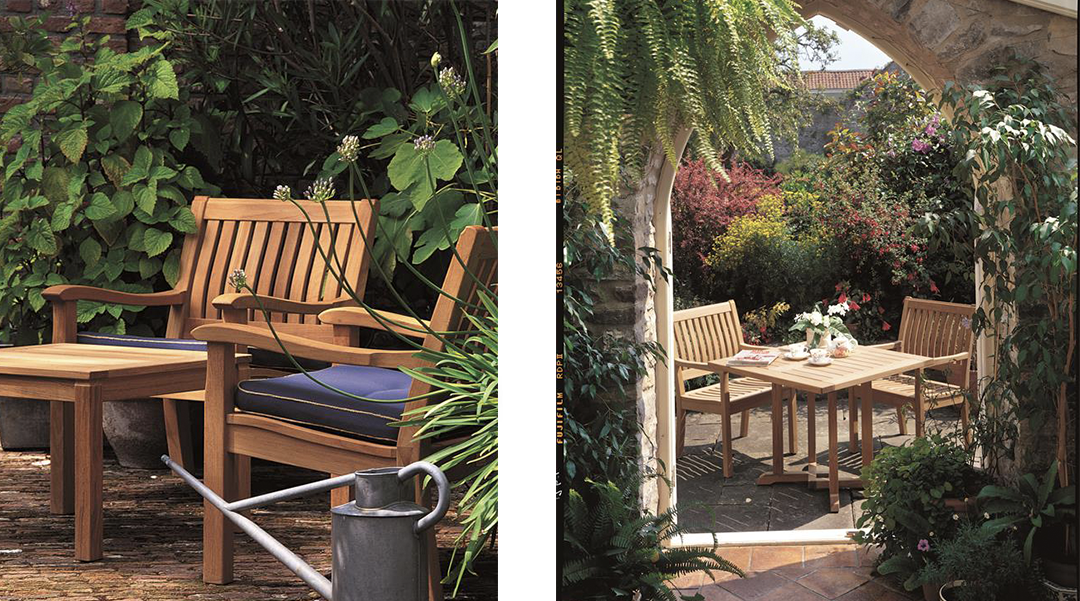
Madison Collection (left); Kingston Collection (right).
With the European business now racing ahead at break-neck speed, Paul’s gaze settled on what would soon become his next venture: the burgeoning North American market…
To learn about the next stage in Gloster’s decorated history, be sure to catch up with us on our third 2021 Quarterly Newsletter arriving in July 2021.